
Review: ALPHA by K. D. Marchesi
ALPHA, the debut novel by K. D. Marchesi, has finally been unleashed, and Rian has a howlin' good time reading and reviewing it. So put your paws in the air 'cause this one gets a little wild!

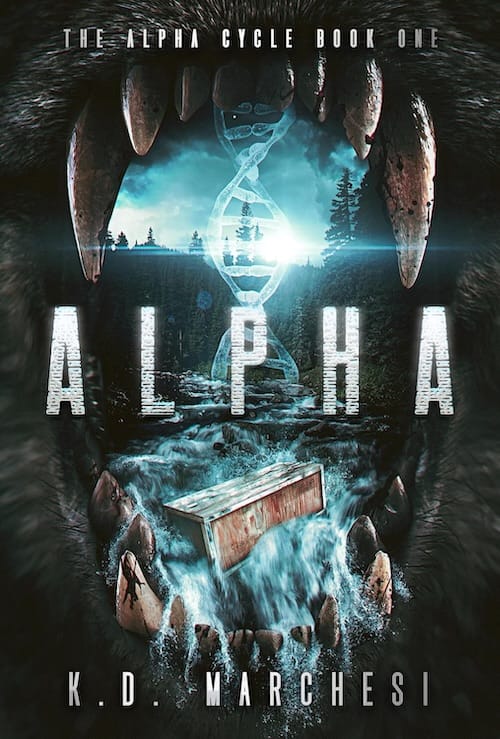
Note: I was sent an eARC of the book by the author in exchange for an honest review. K. D. Marchesi is a very good friend of mine and as such there will be unavoidable biases present in this review. That said, I will always attempt to give a balanced review to the best of my ability. While I don’t give books public star ratings, you may see a 5-star rating for ALPHA on public platforms where this review is posted, and this is representative of a ‘thumbs up’ which indicates that I recommend the book.
SPOILER WARNING!
The below review contains spoilers. Please proceed with caution if you haven’t yet read the book.
Unexpected Introductions
I’ve been wracking my brain for clever ways to compare ALPHA to a wolf, or a pack of wolves, or something even remotely wolf-like, but it seems to me that ALPHA is more like a chameleon. Its story is often well camouflaged, shifting and changing—just like its characters—depending on what the reader expects from it. It can also be incredibly precise at times, like a chameleon’s tongue, striking at the heart of important issues about the self, the body, emotions, family, and inclusion. But, just like a chameleon without the safety of a tree, its vulnerable points are easy to recognise and target when exposed. How visible those weaker points are will depend entirely on the reader. Even so, when we think of a chameleon, we usually think about their unique abilities or just how flippin’ awesome chameleons are, not the best ways to turn them into a meal (unless you’re a starving, bloodthirsty mongrel, I suppose—I had to get a canine reference in there somewhere). The same is true of ALPHA. What has stuck with me upon closing the book are all the things that make it unique. For a self-published debut novel, that’s a commendable feat.
Greater Than the Sum of its Parts
ALPHA is, above all, a story about self-discovery, and the paradoxical way that self-discovery and personal growth often happens amongst the company of others. Caleb, ALPHA’s protagonist, experiences the most growth over the course of the story. He begins as a selfish and immature young adult who rarely has to think about the consequences of his actions, and by the end of the first book has discovered the importance of relationships, trust, loyalty, and many other personal values. But even more interesting to me is the way ALPHA, and in particular Caleb’s journey, can be read as a transgender allegory: an additional layer that makes the story so much richer. Dysphoria and discomfort in one’s body, the excitement, fear, and confusion about the first bodily changes at the beginning of a medical transition, the rediscovery of a new body and all the learning that comes with it, the social impact of transition, and grappling with the inevitable changing emotions are just some of the themes I noticed in my reading of ALPHA.
Brilliantly, Marchesi doesn’t drown the reader in its trans and queer themes, like many authors of queer books tend to do (in my experience). It’s subtle, more of an if-you-know-you-know type situation that you may completely miss or choose to ignore entirely, though it is referenced in the ‘About This Book’ section at the end. As a trans masculine person myself, it was an absolute delight to read the book through this lens and be rewarded for it. But it was also exceptionally uncomfortable at times. ALPHA is a story that is so laser-focused on the body—on bodily sensations and experiences through the body in a very interoceptive way—that I almost felt… trapped. Trapped in Caleb’s body, especially as Caleb’s is the only character point-of-view we are given. This is often the cliché description of the trans experience, the feeling of being “trapped in a body that wasn’t mine” explanation we’ve heard countless times before. Except that we’re not being told or explained to. Instead, we get to experience it, or something pretty damn close to it, through the extended metaphor of the shape-shifter. And that makes all the difference.
Diversity A-Plenty!
ALPHA’s characters are its heart—and its heart is big, strong, and often worn on its sleeve. We get to meet lots of different types of people—and animals, which diversified the characters even more than I was expecting. It was particularly refreshing to encountering characters who happen to be queer without the book needing to explore their queerness.
Some of the characters lift off the page more than others. Argo, Caleb’s best friend, has enough quips and one-liners to show us that the broadness of his personality exceeds that of his already massive deltoids. Others, like Tilon and Ava, are more rational and reserved, and offer a voice of reason that grounds the story amongst all the shape-shifting animal chaos.
Sometimes the characters’ traits or actions are over-exaggerated just enough to enter the realm of caricature, and I occasionally thought that some of the background characters existed to serve the needs of the plot rather than being driven by their own motivations. Caleb’s overly simplistic inner monologue could also be grating at times, and it portrayed him as younger and more naive than perhaps he would realistically be for his age.
The size of the cast, however, is just about perfect. I never felt like I was being introduced to characters quicker than I could keep up with them (something I’m sensitive to), nor did I feel like there weren’t enough characters to make the story and the inevitable drama interesting. Marchesi does a good job of balancing the characters and giving each of them a meaningful moment or two.
Pulling Back the Curtain
A strong heart is useless if not for the supporting network of arteries and veins for which to transport the body's precious lifeblood, and this is how I think of the story’s tone, voice, atmosphere, pacing, and altogether narrative style.
There is a consistent dark and sombre mood that is punctuated by bursts of emotion, moments of optimism, and amusing exchanges of character dialogue that all give a satisfying rhythm to the story and prevent it from becoming too bogged down in its own gloom. Action scenes are well crafted, if occasionally bordering on repetitive as we progress through the story. Suspense and tension builds where it should and is usually met with an appropriate payoff.
And the steaks… I mean, stakes, are high. From the very beginning, with that dreaded encounter with the caged animals in Caleb’s father’s lab, we understand there is a lot at stake. But as the story progresses, and our knowledge of the scale of the experiment increases, the stakes are also appropriately raised and that feeling of dread is raised with them. This shows a level of cohesion that is often missing from even experienced authors of traditionally published work, let alone a first-time novelist. Often to their detriment, many genre fiction novels try to do too much too fast, but I didn’t see a hint of that in ALPHA. Its story is simple, and builds at an appropriate pace.
However, I did sense a battle between character voice and narrator voice throughout the book. While it’s written in the third person, the point of view is exclusively Caleb’s, and some of the language and phrasing were at odds with the way Caleb would understand and interact with the world. Mostly, this comes across as an author still finding their voice, and for that I can’t be too harsh. I look forward to Book Two and, potentially, other points of view where we get to see the author honing in on different character voices, and the way the narration can support each of them.
It’s Science (Fiction), Baby!
Where the characters are the story’s heart, and the style and themes are the blood in its veins, the over-arching narrative is the skeleton holding everything together, and this is where the story starts to roll over and expose its soft belly.
Most of the causes of my howling at ALPHA are from points related to the world-building, specifically the science and the logistics of the experiment taking place. ALPHA is certainly not alone in this, however, being the rule and not the exception when it comes to mainstream or “soft” sci-fi which is typically science fiction in setting alone. Additionally, I will acknowledge this is a New Adult book and not intended to be anything resembling hard science fiction.
First, a quick science discussion to illustrate my point. While “gene splicing” is something that is practiced today, for anything largely experimental it would first happen outside the body (ex vivo). Let’s assume for argument’s sake this has already taken place in ALPHA before Caleb’s story begins. Once approved, it can progress to being administered inside the body (in vivo). However, the cellular instructions delivered through—in the case of ALPHA—an injection would be extremely precise and targeted at specific types of cells (e.g. to correct a fault). For genetic changes to occur on a whole-body scale, gene manipulation would need to take place at the embryo (or sperm/egg) stage where the changes would be adopted by the cells within the organism as it grows.
Now, for Caleb and Argo who were given injections over time as they grew up, and who could have, hypothetically, been modified in utero (I’m convinced that what happens to both of their mothers is a dangling plot thread), I’m willing to suspend disbelief for the sake of a good story. But for the vast majority of characters in the book who are older teens or adults, the laws of biology and physics have to be entirely ignored in order for the story’s premise to work.
But this is a work of fiction! And books like Animorphs do the same thing! Yes on both accounts (and I have the same issues with Animorphs, as did a much younger me), but I don’t bring up this point just to clamp my vicious fangs around the book and tear its pages out, like a raging feral. I mention it because it relates to the bigger issue I have with the plot.
Let’s say Caleb’s dad is a genius and figured out how to get past this pesky issue of full-body genetic changes on demand in fully-grown adults. Well now the bar has been raised for what’s possible and expected, which makes some of the other decisions made by the Big Baddies all the more questionable. Most notable is the need for the raids on the hybrid camps. These raids are a big focus point of the plot and are necessary to cause conflict between the characters and have them move from point A to point B. But they’re an unnecessary, messy, and costly risk. Why not ‘bake into’ your test subjects a way to incapacitate or comply? From the top of my head: nano-trackers in the blood stream, mind control to ‘hijack’ the body temporarily, or even splicing in the genes from those sheep that stiffen up and fall over when stressed… The point is, there are many other ways to move your test subjects around like pawns on a chessboard that would be far more feasible. And even if it’s the social experiment of the subjects that’s the most important outcome, I can similarly think of other ways to achieve the same results with less risk and expense, and far less contamination of the science. From an organisation that is able to create the impossibility of animal-human hybrid weapons, backed by multiple governments, on such a grand scale, I’d expect these smaller problems to be solved with science in much the same way.
As a result, the plot feels contrived at times, serving as a delivery system for the characters actions and reactions, and as the reader I’m pulled out of the immersion. For a similar reason, I would have preferred some smaller, slowly revealed glimpses into the larger narrative through the point of view of Caleb’s father or someone else within the organisation/government/military in order to address those rising doubts about the believability of the experiment.
Concluding Thoughts
Now don't get me wrong. I'm nitpicking (flea picking...? Yeah, OK, I'm done) at ALPHA because a) science fiction is kind of my thing, and b) ALPHA is such a special book that will no doubt get a lot of tails wagging and tongues lolling (I guess I wasn't done). It does so much with so little, and does them in its own unique way that’s respectful of its readers: it’s unabashedly queer without being about queerness; it’s allegorical but can also be read in a very surface-level way as a character-driven survival story; and it has both ideas and heart and intertwines them in a way that makes each of them the better for it. The emotional beats are more resonant because of the experiment and the stakes involved, and the shape-shifting and sciency stuff is supported by the characters who clearly take the lead in this tale.
I'm looking forward to reading the next instalment in The Alpha Cycle, and finding out just how damn long it's going to take for a couple of wolf boys to finally have a good pash (no, Esmay, you're not the only one!).
ALPHA (The Alpha Cycle, Book One) is available to purchase and read through Amazon.